Hi Everyone -
Just a quick announcement that I will be speaking about SunPower Afrique at the PA Renewable Energy Festival in Kempton, PA this Friday at 9AM. While I know the timing for this is tough, if you're in the area please do come by!
For more information on the festival, speakers, directions, etc. please visit the festival's website at www.paenergyfest.com SunPower Builders/SunPower Solar will have a booth there all weekend as well.
If you can't make it, please pass the message along to someone else who might.
Thanks!
Kira
www.sunpowerafrique.org
Monday, September 14, 2009

Thursday, September 10, 2009
Thursday, September 3, 2009
2-3 Septembre, 2009
I am officially addicted to fufu…at the beginning of this week I pretty much panicked at the thought of not being able to find it regularly (the bagged yam flakes that you find in the states are just not the same…) and have found a way to eat it at every meal since Sunday. I often wonder why the preferred meal of the Togolese is (ironically) so difficult to make and spoils quickly, but then I remember, because it is just so good. And rich in vitamins, and fills you up. Togolese cuisine and I have become very good friends.
My last weeks in Togo have been as fast paced as West Africa allows. I have made several trips to Lomé, getting (another) transit visa in order to get to my flight in Ghana, meeting with Maersk at the Port of Lomé to understand the logistics and necessary formalities for transporting my solar panels from the capital to FECECAV’s site in Kpalimé, and trying, again without success, to retrieve my recepissé. However, I made some serious ground, thanks to my dear friend Jacques at the CNM, a little yovo-attitude and a few thousand CFA (of which the latter is usually MUCH more well received…), SunPower Afrique will have its recognition by the Togolese government, and therefore security and relative ease for operations, by next week at the latest.
Everyone here was shocked at my tenacity, as after I was rebuffed and played by the minister’s assistant 2 times, 3 times, and 9 months later, I moved on and went over his head. The Togolese associations, trying to get the same recepissé for their projects (which, to be fair, are often dysfunctional NGOs that only exist to bouff money from the Europeean Union, UNDP and other such well-established international development organs that prefer to evaluate their water sanitation projects from an air conditioned office in Geneva), for the most part, wait. And wait. And wait. And you all know that patience is not one of my strong points (even after all I have learned here in Togo!) particularly with corrupt politicians’ chargés d’affaires.
I now have a friend in the Secretary General of the Ministry of Decentralization and Local Associations, and not only understand the protocols and fees, but have a stamped copy of the law. None of my partners take lightly my ability to get things done here, which is largely a product of the relationships I’ve formed because I embrace people and culture, will talk to nearly anyone but now also know when to keep my mouth shut, and am truly motivated by what I am doing.
On Saturday, Aminou and I gave a 30 minute radio emission on Radio Planete Plus, “The Voice of the Hills of Kpalimé,”explaining what solar energy and SunPower Afrique are, why they’re important in Togo and that if they’re interested, they should come to our solar power demonstration on Monday at Petite Suisse in Kpalimé. MC Jimmy played terrible 80’s love ballads for “breaks” and recorded the radio spot on a cassette, shaking his head with an awo when I handed him a blank cd.
I have been trying since I arrived to recruit people to come to Monday’s presentation, and hundreds of people knew about it. However, and highlighting even more the importance of the market sensibilisation, education and outreach I am doing, only about 40 showed up. And only an hour late. I was thrilled.
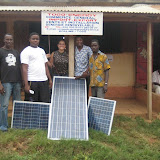
I greeted everyone in the audience and presented the agenda, as required, then gave a brief introduction to SunPower Afrique and why the deployment of solar energy is so critical in Togo. Then I gave a demonstration of how solar energy works, explaining how when the sun hits the panel, the electrons in the silica move around and create current, which is then stored in the battery, sent through the inverter and, ta-da! Lights up an 11watt CFL. Everyone clapped and cheered when the lightbulb came on. It was a great moment, for once I have no words to describe it. I then talked about the mission of SunPower Afrique, the pilot project, the new Solar Loan product and left time for questions and refreshments (which is why people showed up of course :)).
The Solar Loan terms and agreements are ready to go, including carefully calculated and negotiated interest rates and terms that can both maintain our mission of bringing solar to the poorest of the poor and sustain needs for loan management and overhead. Directors and Loan Officers have been briefed and are ready and willing to answer questions when interested clients inquire about the new product – my eyes and ears on the ground to start finding and qualified, interested candidates for the first round of Solar Loans in 2010.
I have learned more than ever this trip that a huge part of this project’s success, as well as my own self-respect, requires me to BE HERE. While I am needed in the states at SunPower, which continues to expand at a record pace, if I want this project to really take off in Togo I am needed on the ground. One month just does not suffice. To do one installation here and there, as with the roofs of MFIs, can be maintained in this way, but to grow the Solar Loan program, which is what I am increasingly inspired by, I will need to spend more time in Togo each year.
The presidential election is in February, which falls unfortunately right when I wanted to return and launch the pilot project. In 2005, there was patchy to severe violence surrounding the elections. Today, people are even more disillusioned with Faure and there is the petite problem of his imprisoned brother Patcha and his supporters. And then there is always the French, with their diplomatic fingers deeply and inappropriately wound around Togolese politics. Clearly the 2010 elections won’t be an example of “free and fair multiparty democratic electrical processes” and I have learned my share about corruption (requiring some selective editing of the Togo section in my business plan…) but will there be violence? No one knows, no one will say, but as opposition and campaign posters have started to appear in Lomé, I can sense the tacit nervousness. People are preparing themselves for February.
After much advice and conversations with my partners, we have determined that it is not prudent (yes for safety reasons, but mostly just for the success of the project…) to start things until after the election. Therefore, I think that we will return to Togo in March, to install the PV system for FECECAV’s HQ here in Kpalimé, as well as spend time doing outreach and vetting and choosing candidates for the first Solar Loans. To do all of this, I am thinking to open a small boutique/storefront for SunPower Afrique en ville.
Sadly, I will miss this weekend’s Epervier’s game, a massive event throughout the country, particularly since they are playing Gabon, a West African neighbor. But I love that when I leave Togo, I am always sent off with a “Go quickly so that you can come back,” to which I respond “Yes, quickly quickly.”
Ѐ Mayimava, kaba kaba looo.
Tuesday, September 1, 2009
Blitta
So much to say and do, so little time. I am not ready to come back to my blackberry. To marketing solutions and powerclerk applications. But this has been a fruitful trip, and I have learned a lot, about corruption and development, about partners and voleurs, about for better and for worse, and for all of it I am continually grateful.
I have written about my experience with my “recepissé” (authorization to operate my NGO in Togo, which I still don’t officially have in my hands by the way) but still haven’t wrapped my head enough around the situation to put it out here in writing. I’ll get there soon. And hopefully by that time I will have the silly little piece of paper tucked safely away in my backpack, having made 15 photocopies and distributed them to be stored in secure locations throughout West Africa.
Last weekend Inno and I took a 3 day trip to Blitta, a small town smack in the middle of Togo (but still considered “The North”, both ethnically and geographically…) where Inno grew up, and where his mother and sister and lots of petit frères and soeurs still live.
We arrived at the station in Kpalimé at 9am, since it can take many hours to get to the north, depending on the condition of the roads, and we wanted to get there before dark. We did not have such luck…
However, my time sitting at the station waiting gave me ample time to consider the cultural beehive (I can’t think of a better way to describe it) that was occurring around me – the Kpalimé station is a mesmerizing place. Everything moves. Everyone is hawking something, shoving handfuls of peanuts and toothpaste and matches into jam-packed vans of sweltering passengers waiting to depart. Barefooted chauffeurs’ apprentices and laborers clamber over mountains of woven plastic bags of charcoal and maize, pyramids of plasticware, and stacked yellow jugs of cooking oil, masterfully securing the towering rooftop cargo with thin cords and canvas. Stern-faced African women survey their goods, hands on hips, hissing angrily if their basket of flipflops is shoved too far beneath a greasy carafe of palm oil. When you think they are done, they add another layer, usually of tires or something heavy to weigh it down. Then the goats, sheep and chickens – they get attached last. It is a miracle of physics not only that these vans very infrequently tip over, but also that nothing ever falls off. Well, rarely.
We waited at the station for more than 4 hours, finally making our grand exit at about 1:30pm.
And a grand exit it was…in a Mitsubishi van were crammed 19 people, 2 toddlers and a chauffeur. Lucky for us, since we were early to arrive, Inno and I found seats next to a real window – as opposed to those that had been reconstructed with layers of clear packing tape. Under a weight of rooftop cargo whose height rivaled that of the van itself, the supportive rocks were removed from behind our tires - which to me seemed far too small and lacking the appropriate air pressure to support the load they bore – and we were pushed by a gang of teenage boys until the engine took and we jolted triumphantly out onto the road. 10 feet later the engine stalled. It was one of those moments when I unintentionally burst of laughing, just couldn’t stop, and, since I had already befriended everyone in the van and tried out my Ewe on them, they too started grinning and clicking and Togo-Togo-ing, even Inno, who tends to be completely and overly composed in public. 5 minutes later we were on our way again.
The road North out of Kpalimé, which we would normally take to pick up the Route Internationale (the best and biggest road in Togo – and the only road for tractor trailers– that goes from the port of Lomé all the way up into Burkina Faso) in Atakpame, is currently impassable. That road, which I so frequently traveled last year through Lavie to Adéta, basically is no more. The 20 minute drive to Adeta now takes upwards of 2 hours by moto. Even small cars can no longer make the trip and chauffeurs, to protect their vehicles, now refuse to take the Adéta road and take the longer route through the town of Notse instead.
The state of the roads in Togo right now is downright deplorable and really, I’d appreciate it if the customs fees I am going to pay to import my solar panels could be applied to, at a minimum, filling in some potholes. I wonder who I could talk to about that…
The Notse road was an experience. It is lined with forests of teak and fields of corn, unpaved and a deep red color. Few craters. Pretty, I thought. Wrong. Within 10 minutes a thin film of maroonish-orange dust had settled on every exposed surface in the van, and was swirling around my feet, in the air and in between my teeth. 10 minutes later it was no longer a film but thick layer of red dirt caked on clothes, fingernails, eyelashes, earings, watches, afros and beards. And we still had 5-6 more hours to go…
Luckily, we arrived in Notse an hour or so later and, since the chauffeur and several other passengers were Muslims, we stopped for them to pray, which gave me an opportunity to wipe off my feet, with a dirty blue windbreaker that people were passing around, before we hit the paved road.
8 hours, 1 can of Chinese-manufactured “brake and steering fluid,” a flat tire and 2 sets of Ramadan prayers later, we arrived in Blitta.
Blitta is a Faure Gnassingbe stronghold. It is the town where he got his start in politics and began being groomed for the presidency… The first thing I spotted driving into town was a big white graffiti that read: “Avec Faure c’est la paix” (With Faure, it is peace.) Interestingly, in this town of several hundred thousand, when the high-tension electricity lines broke down a few weeks ago, Faure bought them a shiny new groupe electrogene (generator) and fuel to power the entire town. The lights go on every morning at 8am, out from noon to 2pm, and then are shut off for the night at 10pm.
Blitta is primarily ethnically Kabye and Kotokoli, which are also the 2 main languages spoken, although nearly 30 languages/dialects are spoken within the town. While when I first came to Togo, Kabye, Kotokoli and their various dialects sounded similar to Ewe and I had a hard time telling them apart, but now they strike me as starkly different. Kabye is a rounder language, words spoken with many trills and rolls, and without that splendid agitation that characterizes Ewe. Wordflow and sentence structure are more connected and legato , making it seem shier and more subtle than its southern linguistic partner.
Kabyes and Kotokolis too have a word for white girl, as I soon learned, when hoardes of children (who see yovos even less frequently than those in Kpalimé, since there is no real reason for a tourist to come to Blitta…unless you want to see a cotton factory, which is the town’s main bragging point) began hissing “Anasarra! Anasarrrrra! Anasarra!”
While in Blitta I met Innocent’s family and drank lots of Tsoukatsouk (pronounced Chook-a-chook), which is the Northern equivalent of Sodabi – but it is more like a warm beer and thankfully tastes less like gasoline burning down your throat. Inno’s mother and sister make and sell Tsoukatsouk out of their house, and people come to drink and be merry throughout the day and night. The biggest customers? Gendarmie and police. Have to be good and sauced before heading to work if you want to be taken seriously as a law-enforcement authority in Togo. I was also completely amazed at how all the children, even babies (think 4 months old) chug down the milky beverage, beads of sweat immediately forming on their tiny foreheads. It is a bit troubling, because yes, there is often a “slight” problem with alcoholism, however subtle and taboo, in rural Africa…
Because the trip was so horrific on the way there, Inno and I opted for the night-route back…meaning we left Blitta at 2am and went directly to Lomé, arriving around 7:30am. Driving through the suburbs of Lomé at 6am was just like driving through at 9am, everyone was already awake, slowly and methodically going about their business. I often wonder if the reason no one sleeps late in Togo is really beacuse of the heat…is it just because everyone else does, because you know you can sleep for 3 more hours in the afternoon, or just because there is just nothing else to do but get on with your day. I often find myself feeling that deep sadness, watching the mothers and grandmothers and daughters and sisters carrying huge pots of water and bundles of wood on their heads at such an early hour, sleep still in the corners of their eyes. We must always remember that we are the lucky ones.
Another update on SunPower Afrique before I head back stateside – I am a bit behind on my blogging, but coming soon! K
Friday, August 28, 2009
Yovo Ameyibo
During the months of July – September/October, the electricity cuts usually only last a few minutes. They are still far too frequent, reminding me every time of the fragility of the supply of energy in this country. When it rains often, the hydro plants in Ghana produce enough electricity to export, and therefore Togo has light…when the Volta region is dry, Togo is in the dark. It’s that simple.
And while during rainy season the blackouts are short they still create a major nuisance for everyone using a computer, having to shut down and quickly save, as transformers blink and beep in exasperation, and (tragically) fans whir to a halt. Not to mention the power surges that drain computer batteries and slowly wear away at other equipment. I’m sitting here in the CECAV-Avenir office, and they have cut the power 4 times in the last 20 minutes, for less than 3 minutes each time – just to give you an idea. Last time it came back on the internet connection came back “limited or no connectivity” and then went down, since it’s so sensitive. It won’t come back until tomorrow.
It never ceases to amaze me how the ever present white noise of technology can fill up an office. And, how here, when that background hum ceases, you hear everything outside and remember where you are – people pounding on sheet metal, staccato Ewe greetings, sputtering 1960s diesel MAC trucks crashing in and out of potholes… (did I mention how DESTROYED all the roads are here right now? It’s pitiable, it takes 4 times as long to get anywhere and if you don’t have a moto, there are several major towns you just can’t get to. More on that later.)
The energy situation isn’t the only thing that’s different in Togo in August. First of all, school is out for summer vacation – the morning and afternoon processions of, uniformed children are no more. And since there are no amusement parks or Julian Krinksky day camps in Kpalimé, the kids amuse themselves with tires and rocks, edito and ludo, and, of course, squealing at yovos.
Nothing dries in Togo during rainy season…ever. Since I’ve been here, the laundry I washed (well, just to clarify, I started washing, and then when my knuckles started bleeding after 5 minutes Inno finished it…yovo skin in so infuriatingly fragile!) in the first week is still damp. Every morning we put it out on the line and race home at lunchtime to bring it in as it starts to downpour – if we’re not too late. It’s hilarious in this completely twisted way…just like the constant stomach problems, fatigue and headaches, and fingers that smell like onions and fish for days at a time.
The other thing that is fascinating about Kpalimé in August is the plethora of tourists! Everyone keeps saying that this year there are more yovos than ever in Togo, since the political problems (at least on the surface…) are becoming a distant past, diplomatic ties with the E.U. have been restored and foreign aid is slowly – SLOWLY – trickling back into the country.
It is bizarre not to be one of the only “established” yovos in Kpalimé, because in addition to the tourists who come for a few days to visit the waterfalls and Centre Artisnal, there are students from France, Germany and Switzerland who come to volunteer with various orphanages, environmental NGOs and community associations. I try so hard not to be judgemental (isn’t that terrible?!) We joke that on sunny days the yovos come out of their hotel rooms to get an African tan and then, when it starts to rain, they disappear. It is however a strange and fascinating reality…
Thursday, August 20, 2009
SunPower Afrique featured on Kiva Blog and linked in NY Times!
Check it out!
(please copy and paste these links into your browser)
http://fellowsblog.kiva.org/2009/08/19/power-to-the-people/
www.nytimes.com/greeninc
Please support our pilot project at www.sunpowerafrique.org!
Tuesday, August 18, 2009
18 Aout 2009: Making SunPower Afrique Happen!
Working on my own here, it’s sometimes difficult and always stressful to stay on task and complete tasks efficiently – particularly in an environment where a) there is an acceptable synergy between sleep and work and b) it often takes a small miracle to print, download or execute any other seemingly menial electronic task…
However, I am slowly ticking off the items on my ambitious list of goals for this trip. Which makes me trés contente :)
My time in Lomé was not spent only staring at landfills and fanning charcoal to make my morning coffee. I had several very important meetings, all bringing me closer and closer to making this pilot project happen. I can’t describe the overflowing excitement that I feel when I think about it…because with the success of the pilot project, SunPower Afrique will surge forward to achieve its goals much more easily – with a concrete project installed on the ground. People will believe me, and they will believe in solar.
1. The CNM
In Lomé I met with Jacques, the Director of Operations at the CNM (National Microfinance Committee), who has proven himself to be a helpful and faithful partner. I briefed him on project’s development, including fundraising, the terms of the “Solar Loan” product, relationships with partners and status of official documents (receipt of my 501(c)(3) and my recepissé…) Jacques mentioned that he had heard wind of some other solar projects being undertaken by a Canadian NGO, an international organization, etc. and that I should hurry to be the first to have something in place on the ground – therefore being recognized as “the first” by the Togolese government. Even more urgency and momentum to SunPower Afrique!
I also shared with Jacques a Memorandum of Understanding that I hope to sign, between SunPower Afrique and the CNM, displaying proof of our cooperative partnership and commitment to work together to achieve both the goals of SunPower Afrique’s programs for MFIs in Togo, but also the goals of the National Strategy for Microfinance in Togo (modernization and informatisation in particular – both greatly supported by reliable, solar electricity!)
2. M. Lare & Training
I also met in Lomé with M. Lare, who will assist with our training program as a Togolese representative and “language liaison” to complement the expertise of Jon (and hopefully Ron C!) Importantly, M. Lare and I also discussed that we will not be taking this project to any ministers or government associations just yet…the political environment here is a complex, multifaceted and fascinating animal. One must allez trés trés doucement…
I also sent messages my other contacts for training in Togo, to discuss the expansion of training programs to technical schools and even the University of Lomé. This is further down the road, but it’s never too soon to get sharp minds on the same page.
3. CECAV-Avenir and the Solar Loan Program
Here in Kpalimé I have been meeting with Daniel, the DG of FECECAV and the champion of solar for MFIs in Togo, who I cannot thank enough for his vision and commitment to piloting SunPower Afrique’s programs with his institution. Daniel and I have chosen a date and started advertising for my presentation to FECECAV staff and clients at the end of the month, drafted and accepted a Memorandum of Understanding. (NB: Interestingly, while Daniel believes in SunPower Afrique, he insisted on adding an “Article 4: Annullment”, which states that “If the PV systems installed by SunPower Afrique do not work, this contract is null and void.” I added it, because this is not a fear I share with my Togolese counterparts. And if we cannot live up to this, what are we doing here anyway?)
SunPower Afrique posters now hang in the CECAV-Avenir salon, and SunPower Afrique Solar Loan pamphlets are at the cash window and in Inno’s office, where most clients frequent. I have already had several inquiries, but it is true, this market will take a while to develop and outreach and sensibilisation will be a massive undertaking…
I also presented to Daniel a draft of the description and terms of the “Solar Loan” – guaranties and collateral, loan terms and interest rates, etc. – which we will continue to finesse and eventually sign a mutally agreeable contract before I leave in September. This document is a huge step forward in making the Solar Loan portion of SunPower Afrique’s project a reality.
4. Abby the Kiva Fellows Blog
In addition to this work with my Togolese partners, there is news on another front. A Kiva Fellow Alum named Abby Gray, who worked in Togo as a Fellow at the same time as I did last year (with different MFIs,) has taken an interest in my project and offered to help me with publicity. She came up with the idea of posting an article on the Kiva Fellows Blog about SunPower Afrique. She then took the initiative to go straight to Kiva and pitch the idea –and they said yes! She has written an incredibly well-composed, inspiring article that will hopefully appear in front of Kiva enthusiasts worldwide! This will be fantastic exposure and I CANNOT thank her enough :) I will post the link to the blog as soon as it becomes available.
5. Darren, Claude and the New York Times!
Thanks to my dear friend Megan Rhodes, Togo PCV Alum (whose work with Chantal and Aklala Batik – www.akala.blogspot.com – has transformed a tiny batik business in Togo into a thriving, internationally known enterprise), I have been connected to a PCV named Darren Legge. Before coming to Togo, Darren was a solar installer in Colorado with Standard Renewables, and is, like me, inspired by the prospects for solar in Togo. Not only has he been working with a man who is starting a renewable energy business (wind and solar), here in Kpalimé and in Atakpamé (Claude Amouzou-Togo of TOGO-ENERGY, with whom I hope to partner in a serious way…) but Darren managed to get a link to my website into an article about solar in Africa in the New York Times!
See here for the article: www.nytimes.com/greeninc
SunPower Afrique has gone NY Times. Yessss. Akpe ka ka ka siaaa.
Subscribe to:
Posts (Atom)


